When your child cracks the pattern, writing takes off.
subordinate clausemain clausePip has already solved this headline.
Clause Paws is a detective adventure that teaches children to use grammar in their own writing — not just spot it on a test. Solve cases with Pip in Pattern City, then write like a detective.
One email when it matters. No spam, no sharing your address. Ever. Privacy policy
Teacher or school leader? Register pilot interest ↓
Built on published researchDyslexia-first by designNo ads, streaks or leaderboards

Fronted adverbials. Subordinate clauses. Expanded noun phrases.
If Year 4 homework has you googling too, you are not alone.
Since 2013, schools in England have taught grammar for a test. Children learn to label word classes and spot clauses — but many still struggle to write well.
The government’s 2025 curriculum review reached the same conclusion our founder’s research did: children need grammar in use, not grammar in theory. The national GPS test may see changes to match. Clause Paws was built for exactly this moment.

Discover the pattern. Name it. Use it.
Every case in Clause Paws follows the loop that Kilpatrick’s (2026) research highlights — and that most grammar practice skips.
Investigate
Sentences are behaving strangely around Pattern City. Your child gathers evidence with Pip: what is this sentence doing, and how does it do it?
Name the pattern
Once they have seen it work, they learn its real name — the same terms they meet in class, from fronted adverbials to relative clauses.
Write with it
Then the pattern goes straight into their own writing — a wanted poster, a case report, a story. Grammar lands where it counts: in their writing.
Creeping along the rooftops, Pip, who never missed a clue, followed the trail while the town slept.
Thirteen cases, one cosy town and a writing superpower.
Pattern City is a warm, lamplit detective town — and its sentences keep getting into trouble. Across thirteen cases, children work through the full Key Stage 2 grammar journey, one pattern at a time, in the order Kilpatrick’s teaching methods follow.
Every case ends with a stamp on the case board and a proper goodbye. Sessions are designed to finish — about fifteen minutes, then Pip says goodnight. There is nothing to lose and no streak to protect.
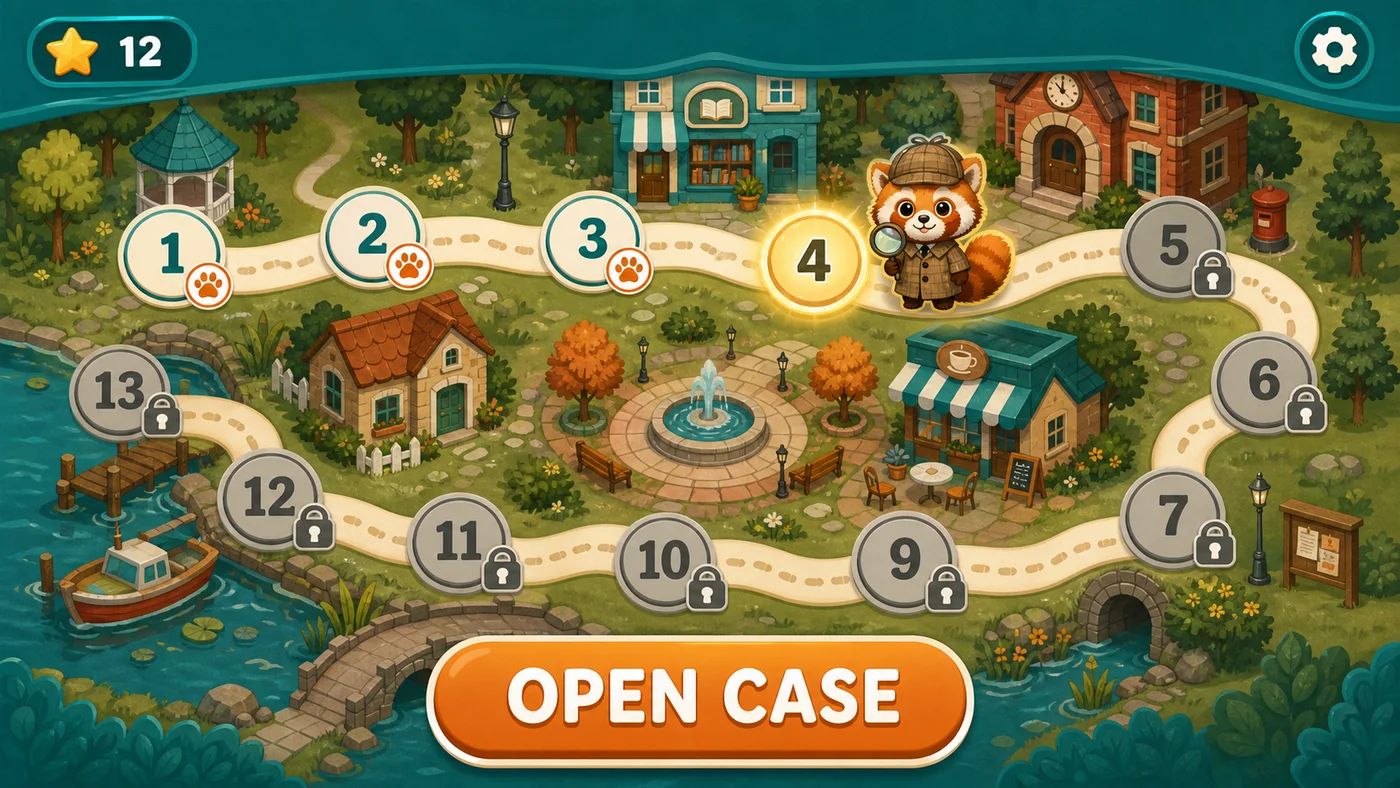
The case map of Pattern City
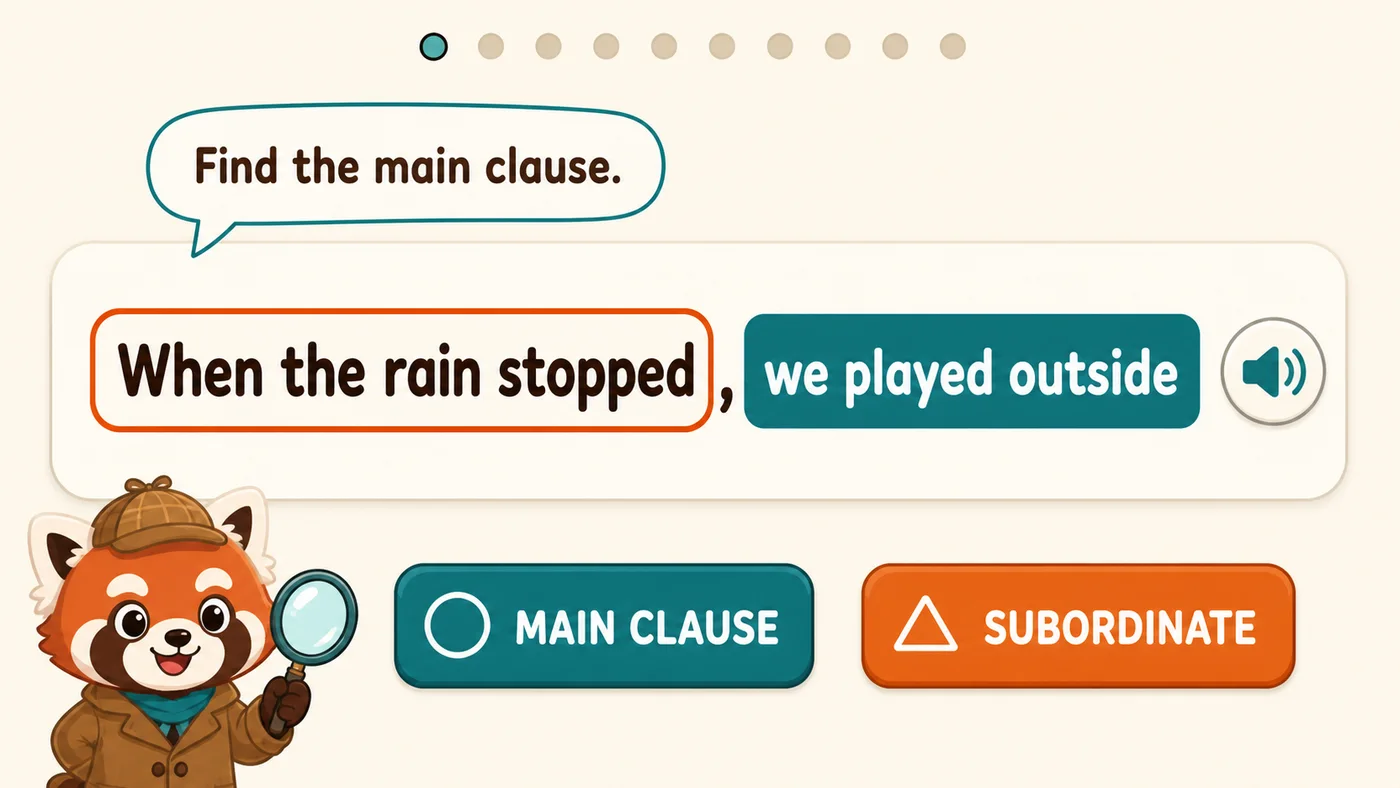
Gathering evidence in a case
Real sentences. Real writing.
Children drag, sort and colour-code real sentences — then write their own and watch the same patterns light up. Every word can be read aloud, so no one is locked out by reading level.
Grown-ups get a simple view of what was discovered this week, in plain English — no jargon, no red pen.
Built like it matters, because it does.
Built on published research
The teaching sequence comes from our founder's pedagogy, which stemmed from her peer-reviewed research — the same grammar-for-writing approach England's new curriculum is moving towards. Progress is measured in children's actual writing, not quiz scores.
Dyslexia-first, always
Designed by a dyslexic founder, for every child. Readable type, calm screens, narration for every word, cream backgrounds — built in from the start, not hidden in a settings menu. This page follows the same rules.
A session that ends
Solve the case, take the bow, done. Clause Paws follows the UK Children's Code: no pressure to return, no fear of losing progress, and screen time you will not second-guess.
We want children to close a case and go write something — not chase a number. That is the whole point.
Meet the founder
Angela Jayne KilpatrickFounder, All-encompass Education · Lecturer, University of Lancashire
Angela Jayne Kilpatrick is a Lecturer in Learning Development at the University of Lancashire, with 14 years’ experience in Higher Education as a Lecturer in English Language and Linguistics. Since 2021, she has worked in the Learning Development Team, supporting staff and students with academic literacy. Angela is a co-developer and author of The Essay Route Map (2025), an online course.
Angela holds a Master’s by Research in Educational Linguistics, which looked specifically at the Grammar, Punctuation and Spelling Test, and has published in the journal English in Education: The Grammar, Punctuation and Spelling Test: An evaluation of the disconnect between declarative knowledge and applied knowledge. She has also been published in The Conversation: Compulsory grammar tests in England’s schools aren’t improving children’s writing.
Diagnosed with dyslexia in adulthood, she brings empathy and advocacy to her work, driving inclusive learning practices at all levels of education. Angela co-founded the Neurodivergent Staff Network, where she serves as Co-Chair, promoting institutional support and awareness for neurodivergent staff and students. She volunteers as a School Governor and is Chair of the Curriculum Committee.
A letter from Angela
As someone with dyslexia, writing has been one of my biggest challenges. At school, I wasn’t taught any grammar. Teachers would often say you must learn how to write more concisely.
Constructing well-formed sentences was a mystery to me. Over my 20 years of teaching, I have seen the same in many students. They might know grammar, but don’t apply grammar to their writing.
My linguistics degree allowed me to discover the patterns in language. Once I figured out the code, I could apply that to my writing. Grammar taught as patterns to explore rather than rules to memorise can change how children understand writing.
Clause Paws is built on research that shows that teaching grammar in meaningful ways through a process of exploration can help children become better writers. Language is a set of patterns, and children are natural pattern detectives. Pip and I just hand them the magnifying glass.
— Angela Jayne Kilpatrick
Pilot Clause Paws with a KS2 class — spring 2027.
We are recruiting a small number of Key Stage 2 classes for a one-term pilot. Two minutes to register, no commitment.
Curriculum-anchored, by nameMapped to the National Curriculum KS2 English programmes of study and the statutory grammar appendix. Supports Year 6 GPS preparation — by teaching use, not just identification.
Evidence you can show governorsPre- and post-pilot writing measures scored against a published linguistic framework, with a simple end-of-term report for SLT.
Light-touch and free during the pilotNo logins, no pupil accounts, nothing to set up or reset — works on the tablets you already have. Whole-class or intervention groups.
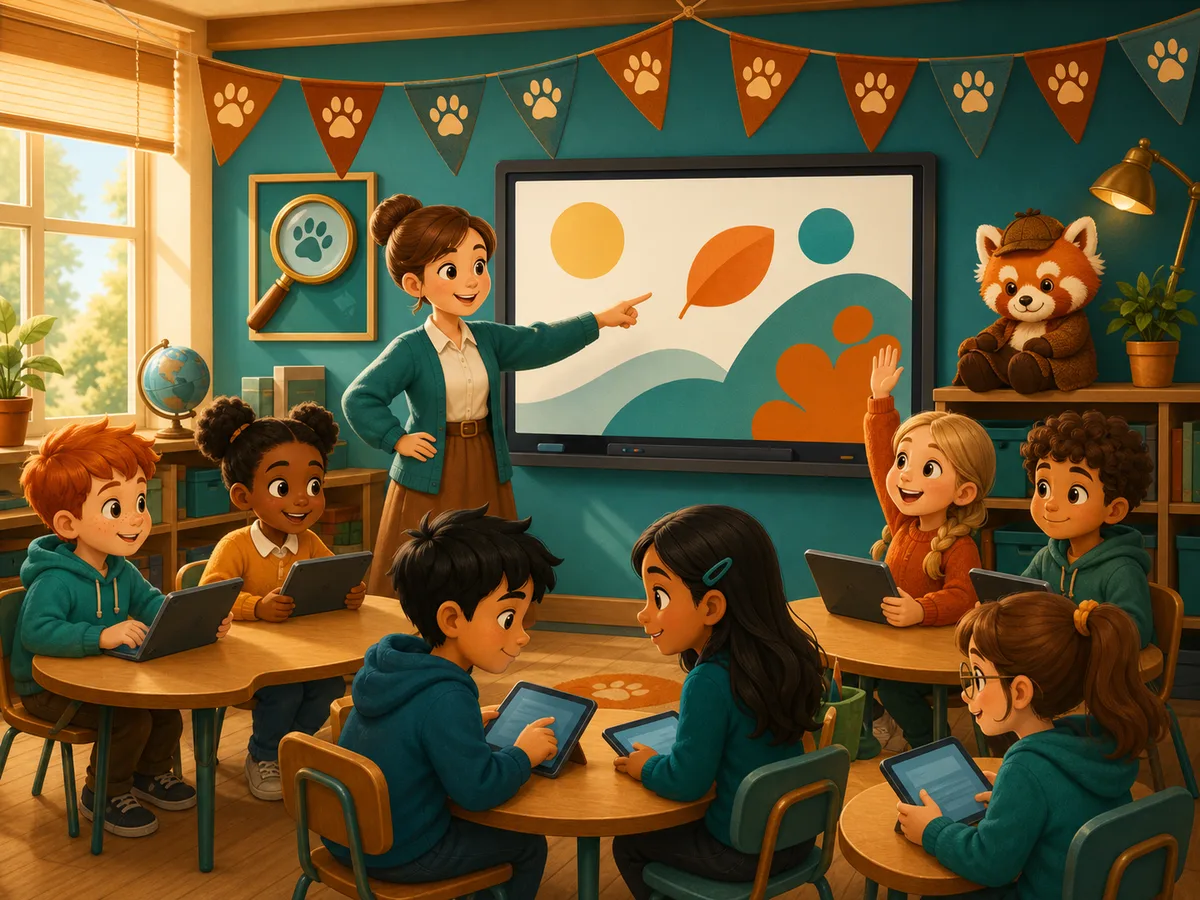
Whole-class or small-group — your call
Data protection, in plain English
- No accounts, no logins — nothing to set up, nothing to reset
- Zero data collection: progress stays on the device, nothing reaches us
- No advertising, no third-party tracking, ever
- Designed to the ICO Children’s Code · one-page summary for your DSL
No commitment — registering interest just keeps you informed as the pilot takes shape. Privacy policy
The parent files
When can we use it?
Schools first: a small pilot starts in spring 2027, and families follow after that. Waitlist members hear first and get founding-family pricing. While you wait, we send occasional postcards from Pattern City — sneak peeks, votes on what we build next, and grammar help you can use now.
Who is it for?
Children in Years 3 to 6 — ages 7 to 11. Clause Paws covers the Key Stage 2 grammar curriculum with the same terms children meet in class, so what they learn with Pip lines up with what happens at school.
Is it just another app designed to hook my child?
No — and we have made that a design rule, not a slogan. There are no ads, no streaks, no leaderboards and nothing to lose. A session is about fifteen minutes and has a proper ending: solve the case, take the bow, done. Pip never guilt-trips anyone into coming back.
My child is dyslexic — will it work for them?
Clause Paws is designed dyslexia-first, by a dyslexic founder. Every word can be read aloud, the typography follows evidence-based readability guidance, and screens stay calm and uncluttered. That is for every child, from the start — not a setting to find.
How much will it cost?
The school pilot is free. At launch we plan one simple family price: no in-app purchases, no locked extras your child will beg for, and an email from us before any renewal. Schools get a straightforward annual price per class.
What happens to my child's data?
Nothing leaves the device. There are no accounts and no logins, we ask for no personal details, and your child's progress is stored on your own tablet and nowhere else. No advertising, no tracking, nothing sold or shared. The whole product is built to the ICO Children's Code.

Case closed for tonight.
Pattern City opens its doors in 2027. Join the waitlist and be first over the threshold.
One email when it matters. No spam, no sharing your address. Ever. Privacy policy